Safari Profile
The Wildlife of Kenya
Wildlife is not confined to parks and reserves although there is a higher concentration in such areas. Thus, although safaris tend to be routed through the reserves, a visitor will often see plenty of wildlife outside.
On an arranged safari a visitor should have little difficulty in recording between 30 and 40 species of mammals and at least 150 bird species. One is certain to see crocodiles and a few lizards (large and small). However, he will have to search hard to find a snake although there are 169 recorded venomous species in East Africa! Much of the land in game reserves is savannah; rich pasture shaded with trees and it is here that herds of antelope are mainly found. A remarkable harmony where several species can graze on the same land, each eating different grasses and herbs and no one species so numerous as to interfere with the domain of others. There are large and small antelopes: the largest - the eland - weighs around 600 kg, a hundred times the weight of the dainty dikdik. Wildebeest, among the most numerous of antelopes, share their grazing with zebra and are naturally gregarious. Smaller antelopes such as the suni, oribi and duiker are rarely found in any numbers. Indeed they are almost always solitary or in pairs. These are the antelopes which inhabit patches of thick cover found in the savannah and some of them, like the duiker, have evolved with shorter forelimbs thereby making the dive for cover easier. 'Duiker' means 'diver' in Afrikaans.
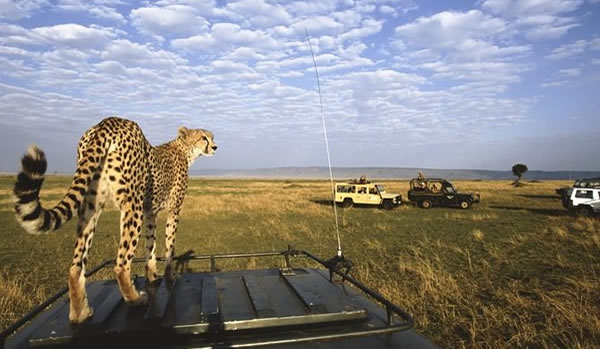
Where there are antelopes there are also carnivores - lion, leopard, cheetah, wild dog, and hyena. The latter is as much a hunter in his own right as the more familiar tag of a scavenger. Lion and leopard are rarely found making a kill in daylight. Not so the cheetah, who needs to be able to see to use his principal weapon, speed. Visitors will see a range of the smaller carnivores - serval cat, genet and jackal. Jackals are also predators particularly the beautiful golden-backed (or oriental) species which again contrary to popular concept, rarely scavenge. Even the most common jackal, the black-backed species, finds only one third of its food from scavenging. But of all the predators, visitors first seek out the lion. These are quite common in most of the parks and reserves but more numerous in the Maasai Mara. Lions spend a good deal of the day sleeping or dozing becoming alert in the early evening especially when the urge to feed increases. Lions are remarkably catholic in their tastes. A lion eats at least 20-25 kg at a meal.
Elephants range across a wide spectrum of habitats from the hot coastlands to the cold moorlands of the Aberdares and Mount Kenya at 3600 m. Few other animals have this range. Elephants are found in most of the parks. Herds of 100 or more can be found in Meru, Amboseli, and sometimes in Samburu. Despite their great size, elephants are remarkably pacific when left to their own devices. The need to maintain its vast bulk (some 150-200 kg of forage a day) keeps an elephant on the move and constantly active. Even at night the incessant search for food continues. It is this restlessness which makes elephant watching so rewarding.
The wanton poaching of the rhino throughout Africa has severely reduced its population, making it necessary to relocate the remaining few to safe sanctuaries. Nairobi, Lake Nakuru, Tsavo West and Tsavo East national parks today hold a number of rhinos. In the Mara and in the forests of the Aberdares and Mount Kenya it is still possible to find rhinos which have not been translocated. The best time to see them is in the early morning. During the day they return to thick bush as their heat absorption capacity is poor. Giraffes roam the savannah with little competition for the tender leaves of the acacia trees which are their principal food. The reticulated species, found north of the equator, must be one Kenya's most striking animals.
Lakes, swamps, rivers and riverine forests support their own specialised wildlife. Hippos, irritable and cantankerous animals, share their habitat with the little-loved crocodile. The largest concentration of crocodiles is to be found in Lake Turkana, and at Sibiloi Park. Between 50 to 60 crocodiles occupy a kilometre of beach. Crocodiles feed mostly on fish. Kenya's rivers and lakes hold a wide variety of fish. The Nile Perch abounds in lakes Victoria and Turkana. It is a notable species reaching enormous proportions - 50 kg specimens are quite common.
The cape (or African) buffalos, adjudged by most hunters to be the most dangerous of big game, inhabit grassland where there is preferably thick cover and swamp in which to lie. But like the elephants they also adapt to life in dense and cold forests. Yet ferocity is clearly not the mark of buffalos in groups. Their herds, which number many hundreds, are quite timid. The major sanctuaries (Tsavo West, Tsavo East, Amboseli, Masai Mara, Samburu and Meru) all feature not less than 50 species. However, there are other areas, such as Maralal and the Tana River Primate Reserve, where there are as many species but in smaller concentrations.
Birdlife in Kenya
Kenya has a more than 1,000 species of birds in a vast variety of habitats.
The big variety of birds is made possible by lack of climatic extremes. Kenya straddles the equator and has only two seasons, wet and dry. In the northern latitudes huge numbers of birds migrate southwards to avoid the harsh winter. From as far east as the Bering Straits and as far west as the northern tip of Norway, they come in their millions to East Africa. It has been estimated that 6 billion birds make the journey each year. Add the visiting birds to the incredible variety of local birds, and you have an ornithological paradise.
Kenya's national parks and reserves have their own quota of this ground variety and with a few exceptions, each one of them covers a different type of habitat. There are of course overlapping areas which need to be taken into account when planning a bird safari. However, even on a more standard wildlife safari, taking in all or some of the major game viewing areas, the birds provide an added attraction.
Of great importance to those planning bird safaris is that the birds can be found in abundance outside the national parks. There are many areas of Kenya covering the same wide variation of habitat, that do not have national park status. In these places game may be scarce, but birds are always present. Examples are: Lake Magadi, only 110 km south of Nairobi in the Rift Valley; Kakamega Forest in Western Kenya, a remnant of the great rainforest that once covered much of East Africa; Lake Naivasha 90 kms from Nairobi; and the thousands of hectares of farmland, private ranches and even suburban gardens in Nairobi. All these areas have plenty of birdlife.
Those keen on photographing birds should use motor vehicles or boats on lakes and rivers. Viewers get closer to the birds than would be possible on foot. The use of hides, on very specialised safaris, can be arranged, and it would be unusual not to be able to photograph many species using this method.
Between 300 - 400 species can easily be seen on a well-planned safari and sometimes as many as 500, provided the basic rules are observed, the most important being time! A rushed safari, trying to cover as many places as possible in the least time, may not yield enough.
A number of field guides and handbooks on birds are readily available in Nairobi. The most commonly used being The Field Guide to the Birds of East Africa by John G. Williams. This book is available in English and German.
The following summary indicates which parks or reserves fall into which major habitats as well as naming some of the principal birds. It should give a bird-watcher on a primarily wildlife safari some idea as to what can be seen.
The Aberdares National Park and Mount Kenya National Park
-
Highland forest and Afro-alpine moorland
A visit to either of these areas provides an opportunity for bird-watching in three distinctive vegetational zones. These are thick highland forest, bamboo forest and Afro-alpine moorland. Highland species found here include several extremely uncommon birds. Green Ibis, rufous sparrow hawk, mountain buzzard, crowned eagle, Jackson's francolin, bronze-naped pigeon, red-fronted parrot, Hartlaub's turaco, scarce swift, white-headed wood hoopoe, silvery-cheeked hornbill, moustached green tinkerbird, fine banded woodpecker, montane oriole, alpine chat, Abyssinian ground thrush, Sharpe's longclaw, slender-billed chestnut-winged starling and no less than 13 species of sunbirds; including the northern double-collared, golden-winged, tacazze, green-headed, variable and scarlet-tufted malachite.
Samburu, Meru, Tsavo East and Tsavo West
-
Savannah bush
These areas are predominantly acacia bush, interspersed with more open pockets of seasonal bushed grasslands. All the parks have large rivers running through them. Tall acacias along the banks attract many species. Notable birds to look for in these areas include: ostrich, vultures, African hawk eagle, pale-chanting goshawk, martial eagle, vulturine guineafowl, buff-crested bustard, chestnut-bellied and black-faced sandgrouse, white-bellied go-away bird, green wood hoopoe, yellow-bellied eremomela, pygmy batis, rosy-patched shrike, Taita fiscal, golden-breasted starling, eastern violet-backed pytilia, as well as a wide variety of starlings, weavers and waxbills.
Masai Mara
-
Savannah grasslands
This is a vast area of rolling grasslands with scattered pockets of acacia woodland. Interesting species include: secretary bird, numerous vultures, eagles and hawks, wattled plover, yellow-throated sand-grouse, bare-faced go-away bird, gabon nightjar, lilac-breasted roller, ground hornbill, red-throated tit, sooty chat, and a wide variety of larks, pipits and widowbirds. In the thick riverine forest bordering the Mara and Talek rivers, several notable birds are found: African finfoot, Livingstone's turaco, Ross's turaco, giant and woodland kingfishers, blue flycatcher, double-toothed barbet and occasionally the rare Pel's fishing owl.
Lakes Baringo, Bogoria, Nakuru and Naivasha
-
Freshwater and alkaline lakes
Four of the lakes in the southern part of Kenya's Rift Valley are alkaline. Lakes Bogoria and Nakuru are frequently the gathering and feeding grounds for huge numbers of the lesser flamingo. Over one million are often present. The greater flamingo are also found in smaller numbers. The freshwater rivers entering Lake Nakuru attract many other water birds, however there is not the diversity of species on the soda lakes as are found on the freshwater lakes - Baringo and Naivasha. Over 400 species have been recorded at each of these lakes and hardly anyone would fail to be impressed by the number of species which can be seen in just a couple of days at either lake. White pelican, pink-backed pelican, cormorant, long tailed cormorant, little bittern, goliath heron, purple heron, squacco heron, little, yellow-billed and great whilte egrets, hammerkop, yellow-billed stork, sacred ibis, African spoonbill, fish eagle, black crake, Aller's and purple gallinules, jacana and pied and malachite kingfishers are all resident. In addition, large numbers of migrant waders and duck may be seen during the northern winter.
The following areas are not normally included in wildlife safaris, but are important habitats for a large number of interesting bird species. These places could be included in a specially constructed bird-watching safari.
Sokoke and Gede Forests
-
Lowland forest
The only areas of true lowland forest in Kenya, the Sokoke-Gede forests are the habitat of some very localised birds, including: cuckoo hawk, Kenya crested guineafowl, Fisher's turaco, Sokoke scops owl, green barbet, red-tailed ant thrush, east coast akalat, forest batis, Sokoke pipit, Retz's and chestnut-fronted helmet shrike and the amani sunbird. Additionally, from June to October four species which are very rare in East Africa can be seen, these being the: African Pitta, the Scaly Babbler, the Spotted Ground Thrush and Clarke's weaver.
Northern Kenya
-
Desert and Semi-desert
The desert around Lake Turkana and the vast area to the east, including the Dida Galgalla, host a variety of birds. Sand desert, rock desert and lava fields are found with some grass cover occurring after rains. Acacia grow in scattered clumps or strips, particularly along the numerous dry-river beds. Larger areas of semi-desert scrubland border the true deserts wherever slightly higher rainfall occurs. The birds here include: swallow-tailed kite, fox kestrel, Heuglin's bustard, cream-coloured course, Lichtenstein's sandgrouse, Abbyssinian roller, masked and crested lark, William's bush lark, brown necked raven, Somali fiscal, white-crowned starling, shining sunbird and Somali sparrow.
Kakamega Forest
-
Central African Rainforest
This is the easternmost extension of the vast rain forest which covers much of Zaire and Uganda. Today Kakamega is a "forest island", and an excellent venue for bird-watching. It has many species not found elsewhere in Kenya. Grey parrot, great blue turaco, blue-headed bee-eater, black and white casqued hornbill, yellow-spotted barbet, hairy-breasted barbet, brown-eared and yellow-crested woodpeckers, African broadbill, many species of illadopsis and greenbuls, southern hyliota, Jameson's chestnut and yellow-bellied wattle-eyes, pink-footed puffback, red-headed bluebill and oriole finch.
Fishing
Fishing has many addicts worldwide and most Kenya tour operators can organise specialised fishing expeditions with the help of one or more fishing centres. Game fishing at the coast can be combined with lake fishing in lakes Victoria and Turkana, and some lovely trout streams in the Aberdares, the Mau and the Cherenganis.
Besides inland fishing on lakes, rivers and streams, where the angler's rewards include the giant Nile Perch, black bass, rainbow and brown trout; Indian Ocean sport fishing extends all the way from Lamu in the north to Shimoni and the Pemba Channel bordering Tanzania in the south. This area has developed in recent years into a major tourism attraction in its own right.
Many international deep-sea feshing sportsmen, from as far as Australia and Japan, the United States, Canada and Europe, as well as neighbouring African countries, now visit the Kenyan Coast simply to fish, and their numbers continue to grow with sophisticated charter boats and crews operating the length of the Coast. The main areas of focus for visiting fishermen are Malindi and Watamu in the north, Mtwapa Creek and neighbouring Mombasa in the middle and Diami, Shimoni and the Pemba Channel in the south.
These places offer fleets of charter vessels and shoreline accommodation which ranges from the comparatively modest to five-star resorts.
There is also an unsurpassed variety of superb deep sea and in-shore creek fishing. Many record-breaking marlin catches - blue, black and striped - have been clinched in the Pemba Channel, while Malindi boasts a year-round sailfish population, comparable to the best in the world.
Further out, between 30 and 50 km, on the Malindi and Watamu broadbill for the overnight adventurers, kingfish, wahoo, barracuda, dorado, giant trevally and a host of bottom fish when angling for the pot, coupled with an extensive season stretching from early August right through to the end of April; which makes Kenya's deep-sea fishing unique and competitive.
For the visitor, enjoying a favourable rate of exchange against the Kenya shilling, the charges are reasonable. There is an ever-growing body of international sports fisherman who have learned that combining a deep-sea fishing trip with a wildlife safari makes Kenya not only a first-class destination, but a unique one too.
The Kenya Association of Sea Angling Clubs (KASAC), affiliated to the International Game Fish Association (IGFA), has had a very favourable response over the recent years to its efforts in encouraging the tagging and releasing of bill fish, especially the smaller sailfish, marlin and broadbill. In a recent international competition hosted by the Malindi Sea Fishing Club in November 1993, it was no surprise that while the top 10 boats alone caught 79 sailfish over the two days, no less than 76 of these were tagged and released, the remaining three being boated because they were too deep hooked or otherwise injured.
What is also of great interest was the number of sail caught - quite apart from probably 100 more that were raised. These figures which are taken for granted in this area must certainly be the envy of a great many famous resorts elsewhere in the world.
KASAC has campaigned over the years for a code of conduct as well as enforcing standards backed by legislation, that would assure greater safety and eliminate the fly-by-night pirate operators who offer seemingly bargain prices, but are not adequately equipped or even properly insured.
It is the special bargain hunter who often finds that the "saving" of a few thousand shillings on a day out, has led only to disappointment. For the discerning visitor it is still advisable to deal only with the recognised and well-established charter operators. Many are properly insured and equipped, providing seasoned skippers and crews as well as the best in modern tackle.
By John De Villiers
Sub-aqua Pursuits
Drivers, prepare for surprises. Kenya is the equivalent of the Matterborn - irresistibly attractive! The waters are abundantly blessed with life. The water is clear and consistently warm. There are reefs, wrecks, walls, canyons and caves to be dived. The fringing reefs provide the dive sites and visibility is normally in excess of 20 metres. Examples of moray eels, groupers, octopus, scorpion fish, lobsters and rays are all plentiful. There are breathtaking sponges and coral covered drop-offs and the reef explodes with life. Most evident, of course, are the fish - moving, darting, hovering and again and again sweeping past in waves. Descending you notice many parting shapes, many you may have seen before although few can be named. Squirrel fish, butterfly fish, damsel fish and in the distance a shadow emerges; great wings carry the ray nearer. You watch in wonder as it glides away, silently, as it arrived.
Corals flourish in warm clear seas and on any one of our healthy reefs you can find as many as 40 coral species. Not many divers can handle the identification problem.
Service on all diving along the Kenyan Coast is likely to surprise you. All you are expected to do is to get kitted up and there is ample room to do that. In the meantime your B.C. and regulator have been fitted to the cylinder for you. Your gear is put on and after a swift check, in you drop. When you come back there are helping hands to take your camera, weight belt and fins. Your B.C. is removed and before you have time for a rest your gear is fitted to a fresh cylinder and you are ready for your next dive.
Dive sites vary greatly; some are quite commercialised. Others offer almost virgin diving. On the North Coast, Watamu is a perfect situation with several nearby coral reef. Dive training can be undertaken in courses offered by the British Sub Aqua Club or the Professional Association of Diving Instructors. There are three dive centres at Watamu and daily diving for experienced divers. Not far north of Mombasa, at Vipingo there are some good dive sites with swim through caves. However, these are strictly for experienced divers. Boats can be hired at Kilifi in order to reach this site. A few kilometres north of Mombasa, at Bamburi, there are several diving centres. Most of these offer C.M.A.S courses. Along this stretch of Coast you are quite likely to see crocodile fish and the dive sites are only a 20 minute boat ride away.
On the South Coast, Tiwi has a small, privately run, scuba diving operation where the aim is to provide a special atmosphere away from the more widely used areas. At Tiwi, instructors are PADI qualified and courses are available for novices. These range from a short course taking two to three days and consisting of theory, pool training and an open water dive, to a comprehensive course leading to international certification. The PADI open water course takes five to six days and is the most popular. Courses for more experienced divers include Advanced Open Water, Rescue Diver and Dive Master. At Tiwi, there are a variety of dive sites within 10-40 minutes boat rides from the school. The best months are between September and April, and although visibility depends, of course, on the weather. It is generally good throughout these months. Various types of hard and soft corals can be seen and on occasions whale sharks and mara rays are present. The lucky diver will sometimes see schools of dolphins racing across the reef. Night dives are perfection itself. On a moonlight night diving here is magical. As you descend the blackness becomes alive. Giant squid, large lobsters and crabs are in abundance. Coral polyps are out feeding in an exuberant display. Turtles come out to mellow overnight but also swim freely over the top of the reef with you. South of Tiwi is Diani Beach where there are a number of commercial diving centres although the diving sites are further south at Galu and Kinondo. These sites are popular but can suffer from an excess of divers.
Near Shimoni, not far from the Tanzanian border you can dive from large dhows. These are often surrounded by dolphins. You can relax between dives on several small islands.
Diving has become an important visitor attraction in Kenya. The unpolluted waters, the spectacular vertical walls and the great visibility have ensured this. Wherever you dive you will not be disappointed.
Special Interest Tours
Whilst the majority of visitors come to Kenya to see its wealth of wildlife or to luxuriate on its spacious , sun-caressed beaches a growing number come to savour its lesser known delights. Some travel with societies and clubs to thrill to the richness of Kenya's bio-diversity or to specialize and enrich their particular interest. Others are ecotourists who are aware that Kenya is unspoiled by the attitudes and the commercial exploitation which has sullied the reputations of more well-known destinations.
Orinthological Safaris
- Species identification only: The idea is to see and identify as many species as possible, adding these to a list of birds seen in other parts of the world. In birding jargon this is known as "twitching" or "ticking" and draws an enthusiastic band of followers.
- Species identification, combined with a more detailed study of some selected species as and when need arises. This is "birdwatching".
- Species identification, detailed study, with the accent and concentration on bird photography.
Kenya's wealth of birdlife has been outlined earlier but tour operators who specialise in bird safaris divide these into three categories:
Each of these requires different planning, a different approach and a different type of itinerary. For the first two groups, bird oriented-societies such as the Audubon in the USA and the Royal Society for the Protection of Birds in the United Kingdom organise tours for their members and set these up with reputable tour operators in Kenya who have the skills, and are willing to care for this particular enthusiasm. The third specialisation requires the services of an operator who is himself a keen and competent bird photographer or who can provide one. These skills are available in Kenya. We strongly recommend that they be hired.
Golf in Kenya
One of Kenya's best kept secrets is its numerous golf courses. Few places in the world offer such perfect ingredients for a fantastic golf holiday, as Kenya. The opportunity to play your favourite game, to see wildlife (sometimes on the course!) and to relax on the beautiful white sandy beaches during the same holiday is unique.
In the early 1900s British colonists began developing golf courses all over the country. They realised that Kenya had a favourable climate and beautiful setting for the construction of some of the world's best courses.
One of the most appealing features of golfing in Kenya is variety. From the beach clubs set among palms and casuarinas with stunning views of the sapphire Indian Ocean, to those dominated by the perennial snow-cap of Mount Kenya, there is a medley of courses each vying for priority as the most attractive location. One is built on the slopes of an extinct volcano!
Kenya has 36 golf courses of which 10 are 18-hole, nine of which are used for championship events. Six are within a 20-mile radius of Nairobi - Kenya's bustling capital. The oldest course is Royal Nairobi Golf Club (7021 yards - par 72 - 18 holes) founded in 1906, the latest is the Windsor Golf and Country Club (6751 yards - par 72 - 18 holes). There are several new courses under construction and a number are being up-graded from nine holes to 18 holes.
The weather is ideal for golf throughout the year. On occasions you might need a sweater or a jersey, but will usually play in a polo shirt.
In the highland areas, the temperatures are in the low 20's and at the Coast in the high 20's or 30's. There are 12 hours of daylight and, depending on the season, four to nine hours of sunshine. During the two rainy seasons, (April and November), the rain usually falls before 10 am and after 5 p.m. and almost never when you are playing! More and more clubs are installing sophisticated fairway watering systems to keep the course green during the dry season.
Many courses are at an altitude of more than 1500 metres (5000 ft.), giving you an additional 10 per cent yardage to your stroke.
Most clubs have a pro-shop where you can buy whatever you need. Though there are no golf carts, Kenya has the luxury of caddies. Usually the caddies are very good players themselves and will not only carry your bag and look for your ball in the rough, but will advise on local rules, assist with your swing and generally be your companionions and mentor. Kenya's golf clubs are generally quiet, especially during weekdays. One or two clubs do not admit visitors at weekends but most do, except on competition days.
Visitors who want to play golf are best advised to approach one of the several tour operators organising golf holidays. A few specialise only in golf safaris and give a personalised service. Many of the larger general tour operators now offer golf in their programmes.
For the visiting golfer, Kenya has a broad appeal. There is everything for the fantastic golfer, whilst the avid golfer can fashion his safari to include some wildlife viewing as well. A golfer who prefers to laze on the beach can still fit in a game or two and the business traveller, with an afternoon off, can easily play his favourite game right on his doorstep. Many city hotels have made arrangements with local courses for temporary membership for their business visitors.
Kenya has it all and golf is no exception.
Mountain Climbing and Hill Walking
Mt. Kenya is the main attraction for serious climbers. The north face route to Batian (the highest peak - 5199 m) is Grade IV+ and the south east face of Nelion (5188 m) is Grade IV. Hill walkers can easily reach the third peak Lenana, 4985 m. The peaks are the remains of the "plug" of an ancient volcano, estimated at 3 million years old. The original cone, now worn away would have made the summit considerably higher than Kilimanjaro. With 10 mountain ranges exceeding 3000 m, and a multitude of lesser hills, some clad in the dense forest, others rising stack from the desert (and all offering the chance of encounters with wildlife !) hill walking in Kenya is certainly hard to beat. Still, with the outdoor enthusiast specialised tour operators offer pony trekking, horse safaris and camel safaris. And if none of these appeal to you, there are escorted walking safaris. An interesting event is the International Camel Derby held every October at Mararal.
Cycling, Canoeing, Rafting, Sailing, Windsurfing, & Scuba Diving
Horse Racing and Others
As a spectator spot with an avid following, horse racing is unparalleled. Racing takes place at the beautiful Nairobi Racecourse on 40 days a year, almost all Sundays. The stunning finds in the field of paleoanthropology, which have earned Kenya the sobriquet "The cradle of mankind", now attracts visitors from all over the world. A safari to the eastern shores of Lake Turkana can be combined with an expedition through Samburu District where Japanese scientists have uncovered 8-million year old apelike fossil remnants. Still, in scientific circles, tours are arranged for archaeologists who will be interested in the excavations at the Coast where well-preserved remains of many city states, dating back to the 9th Century, have been uncovered. There are interesting sites, too, in western Kenya and numerous stone age finds mainly in the Rift Valley. Horticulture, which is a flourishing industry in Kenya, and its sister, floriculture, attract a number of special interest groups. These include botanists and orchid lovers or just plain gardeners for whom tours are arranged with the help of the Kenya Horticultural Society. Farmers, too, are catered for and tours are arranged through the wide spectrum of farming. An interesting but under-utilised possibility is the light aircraft flying instruction. Top instructors are available in Nairobi and Mombasa and the constant good weather makes it possible to qualify in a remarkably short time. Gliding can be learnt and practised at Mweiga and near Nyeri, not far from Mt. Kenya. This review of special interest safaris is not complete. At various times arrangement have been made for groups as diverse as railway enthusiasts and entomologists; rock hounds and lepidopterists.
Conferences
Kenya joined the world league as a conference destination after the completion of the striking Kenyatta International Conference Centre in Nairobi in 1973. This immensely practical conference centre complemented Nairobi's other attractions notably a pleasant year-round climate, a unique array of pre and post-conference tours and a wide range of accommodations all within walking distance of the centre. The centre opened with a World Bank conference for 4,000 delegates.
The centre caters not only for giant single meetings but also for small working groups, sub-committees and secretaries. Apart from the enormous plenary hall of 2415 sq. m, (often used for exhibitions) there is a dramatic amphitheatre which seats 800 at tables on three balconies encircling the auditorium , two medium sized conference rooms and two smaller rooms in one. Services are excellent. Banks, tour operators, airline booking offices, boutiques and restaurants are within the complex. Simultaneous interpretation, telex and telefax, international telephone services and a fully equipped press centre make the Kenyatta International Conference Centre suitable for the most fastidious of congress organisers.
The Centre currently hosts about 40 major conferences a year and the number is growing. It is important to note that the favourite month for conferences coincides with Nairobi's hotels' period of lowest occupancy.
Conference facilities also exist, on a smaller scale , in Nairobi and at several dramatic locations throughout the country. For those entitled to use it, the United Nations Complex at Gigiri, on the outskirts of Nairobi, has a custom-built facility with eight rooms , two of which can accommodate about 500 participants each. The Charter Hall within the Nairobi City Council's precincts, and close to the Kenyatta International Conference Centre, can seat 1,000 participants, theatre style and has simultaneous interpretation equipment. All the major Nairobi hotels have conference facilities. Of these Safari Park Hotel has a custom built centre which can accommodate 1000 people. The Hilton and the Inter Continental both have meeting rooms which can house 400 participants. Outside Nairobi, the Mt. Kenya Safari Club at Nanyuki, is a luxurious destination with a facility for 100 persons and such a romantic destination is certain to draw delegates. Other centres are at Nyeri and Tsavo National Park and even at a tented camp in the Maasai Mara National Reserve. At the Coast several hotels have purpose built conference rooms, notably the Inter-Continental, Mombasa and Nyali Beach Hotel. Many others have multi-purpose function rooms which can be used for smaller meetings. Kenyan tour operators are well experienced in handling conference traffic, both accommodation reservations and transport requirements. Additionally, they can buy in, or in some cases provide further services such as interpreters, P.R and print. Kenya is a conference country.
Incentives
The incentive market is possibly Kenya's fastest growing segment within the tourism industry. This is, perhaps, not surprising as the country offers such a wide range of activities. Many of the Coast hotels can offer sufficient rooms for incentives of 200-300 people. Nairobi hotels can also handle these numbers and at the same time offer a wide range of leisure pursuits ranging from casinos to golf. African theme evenings are no problem at both the beach and city hotels. Often incentives are combined with safaris and although the safari circuits cannot handle the large numbers as can beach and city hotels, it is possible to accommodate up to say 80 participants. If the incentive organisers are willing, the safaris can be run on a back to back basis so doubling the possible numbers. Another way in which large groups can be handled is to have a base at a large hotel and fly groups, daily, by light aircraft to a variety of parks. In addition to the Coast and Nairobi, the Mount Kenya Safari Club at Nanyuki makes an ideal base for such an arrangement.
As with study tours, it is often possible for participants in an incentive group to meet their Kenyan counterparts.
Cruises
A growing number of cruise ships are including Mombasa in their itineraries. The attractions are obvious - flying safaris to the more distant parks and road safaris to Tsavo and Amboseli are easily arranged - as are visits to Lamu and even a day out at sea, in a different vessel, taking in some deep sea fishing.
All members of the Kenya Association of Tour Operators are able to arrange to meet visiting cruise ships and can pick up clients at the dockside and deliver them back when the tour or safari is over.
| Travel Advisory | Safari Profile | Accommodation |
| National Parks & Reserves | Tour Operators & Travel Agents |
| Main Touristic Centres & Regions | References | Kenya Wildlife Service |
| Sign Our Guestbook | Site Search |
Copyright © 1996 safariweb.com. All rights reserved.
For comments, suggestions and further enquiries, please contact info@safariweb.com
Tour operators
- Uganda Safaris & Tours
- Gorilla Safari Company
- Uganda Gorilla Tours
- Africa Safaris Uganda
- Uganda tour Operators
others
SafariMate
An independent magazine on African Cultures, Travel and the Environment. click here>>>
mailing list
Join our Mailing List to receive regular updates on new products, travel-related news and much more. click Here >>
![]()
Please E-mail us your comments
![]()
Click here to join our mailing list.
![]()
sitemap
![]()
Designed by: ACS